
Somewhere Between Autonomy and Autopilot
Modern life feels increasingly automated...

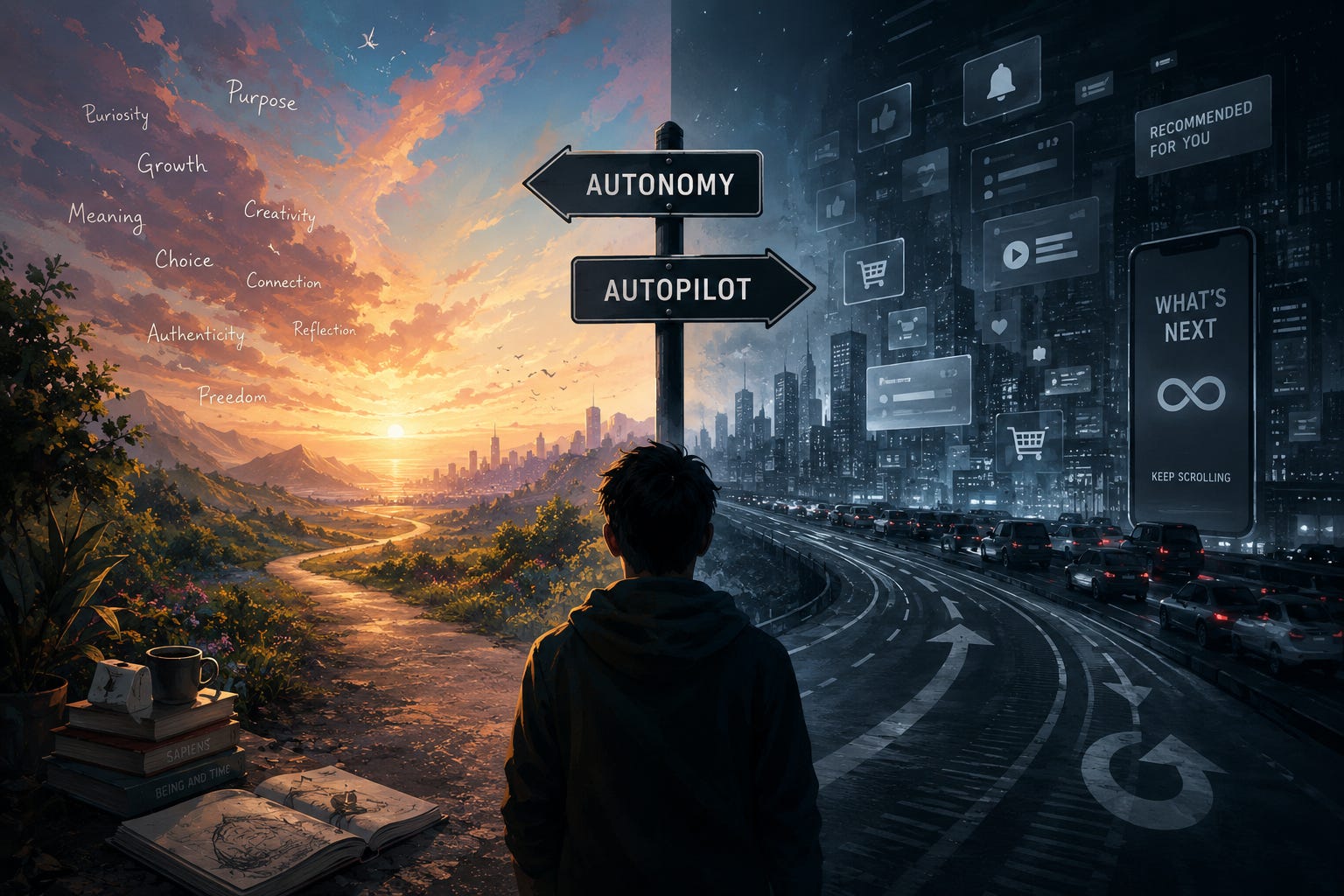
You stand at a crossroads. Left or right. Stay or leave. Speak up or stay silent. In that moment, it feels like you’re choosing.
But are you?
Do we truly have free will? Or is that just a story we tell ourselves — a comforting myth in a world ruled by cause and effect?
You wake up late, skip breakfast, snap at someone you love. Later, you regret it. Was that your fault? Or was it the bad sleep, the stress at work, the thousand invisible pressures pushing you toward that outcome? Where does you begin, and everything else end?
Philosophers have wrestled with this forever. In ancient Greece, the Stoics taught that we don’t control what happens to us, only how we respond. In other words, we’re free not in our circumstances, but in our reactions.
But even that raises another question: who is doing the reacting?
Are you the sum of your thoughts and upbringing? Your habits? Your biology?
Science only complicates things further. Neuroscientists have found that our brains often “decide” before we’re consciously aware of it. Split-second reactions, gut instincts, even moral judgments emerge before we think they do.
So if the decision is made before we’re aware of it, did we really choose it? Is free will just a delay in consciousness, a trick of the mind?
Religion holds a mirror to the question too. In Judaism, free will is sacred. You’re held accountable because you can choose. “You have before you life and death,” says Moses, “choose life.” But how free are you really if your nature was formed in the womb?
Christianity also holds free will in tension with divine foreknowledge. If God already knows your path, is it still yours?
Islam speaks of God’s perfect will, but also human responsibility. “God guides whom He wills,” yet you are still accountable for your choices.
It’s a paradox: predestination and accountability. A map that’s written, but still lets you walk it.
Maybe they’re not contradictions, but complements. Maybe freedom isn’t total, but real enough to matter.
And then there’s lived experience. You’ve made choices that changed your life. You’ve also felt stuck — like life was choosing for you. Like you were just reacting. Like you didn’t really have a say.
Freedom isn’t black or white. It lives in the grey — not absolute freedom, but meaningful freedom.
The freedom to pause before reacting. To choose kindness even when angry. To write a new story even when the old one still echoes. That kind of freedom changes things.
Viktor Frankl, who survived the Holocaust, once wrote: “Everything can be taken from a man but one thing: the last of the human freedoms, to choose one’s attitude in any given set of circumstances.” If anyone had a reason to doubt free will, it was him. And yet, he believed in it fiercely.
Because in that small gap, between what happens and how we respond — lives our dignity. Maybe free will isn’t about choosing every detail of your life, but choosing what kind of person you’ll be within it.
And perhaps that’s enough. It’s the kind of freedom that matters.
Absolutely beautiful piece, Rob. I would argue with Frankl that we get to "choose one’s attitude in any given set of circumstances". Sure, we are free to consider the possibilities that we know about. But actually exercising something you never mastered, or never had modelled for you, or didn't even realise is an option, or was simply not in your nature (a nature you didn't choose) is another matter entirely. Perhaps Frankl was gifted his ability to exercise a positive and enduring mindset by his upbringing. Perhaps he should count that as a privilege to set against the suffering he experienced. Perhaps he already does. Perhaps others looked at Frankl and simply couldn't do what he did. Perhaps!
Here's my piece on freewill: https://mediumqualitythinker.substack.com/p/we-do-not-have-free-will?r=47jm5f&utm_campaign=post-expanded-share&utm_medium=web